



About
Dr. Binod Shah is a distinguished academician, researcher and administrator with extensive experience in management education. He is currently Professor in the Faculty of Management at Tribhuvan University. He has served as the Dean in the Faculty of Management at Rajarshi Janak University. Dr. Shah has published numerous research papers in reputed national and international journals, showcasing his scholarly expertise. Additionally, he has presented papers at national and international conferences, further enriching scholarly discourse in his field. As an author, Dr. Shah has contributed significantly to management education through his authored and co-authored textbooks, catering to various levels of study. He has participated in Faculty Development Programme (FDP) at Indian Institute of Management, Ahemdabad (IIMA).
Skills & Expertise
business administration
Case Analysis
Research Interests
Business Management
Financial Management
Accounting
Connect With Me
Experience
Head, Management Research Cell

Dean, Faculty of Management

Director, BBA
Planning and implementing for BBA Program
Education

Tribhuvan University
Babasaheb Bhimrao Ambedkar Bihar University (BBABU)
Tribhuvan University
Conferences & Seminars (6)
1st JSMMC National Conference 2026
Academia–industry collaboration has become a cornerstone of modern higher education systems, particularly in the context of the knowledge-driven global economy where innovation, employability, and technological advancement are key determinants of national competitiveness. This plenary paper examines the current status, major issues and challenges, opportunities, and future directions of academia–industry collaboration in higher education institutions in Nepal. Despite increasing recognition of the importance of linking universities with industries, the study finds that collaboration in Nepal remains at a developing stage and is largely fragmented and informal in nature. Although initiatives such as the University Grants Commission’s Labor Market Driven Program (LMDP) under NEHEP and emerging partnerships between selected universities and industries indicate positive progress, effective institutionalization of collaboration is still limited.
The paper identifies several critical challenges hindering effective academia–industry engagement, including curriculum–industry mismatch, weak research and innovation ecosystems, inadequate policy and institutional frameworks, financial constraints, communication gaps, limited internship opportunities, brain drain, insufficient industrial participation, and technological disparities. These challenges collectively contribute to a persistent gap between academic outputs and labor market demands, affecting graduate employability and innovation capacity in Nepal. However, the study also highlights significant opportunities such as digital transformation, a growing youth population, expanding startup ecosystems, increasing industrial awareness, globalization of education, and policy reforms aimed at strengthening labor market relevance.
The paper further suggests future directions focusing on curriculum reform, experiential learning, applied research, establishment of innovation hubs, strengthened industry advisory mechanisms, and enhanced government–industry–university coordination. A more structured and policy-driven collaboration framework is essential for transforming higher education institutions into innovation-oriented and employment-responsive systems. The paper concludes that strengthening academia–industry collaboration is crucial for enhancing human capital development, fostering innovation, and supporting sustainable economic growth in Nepal.
Keywords: Industry–academia collaboration, higher education, employability, innovation ecosystem
INTERNATIONAL SEMINAR ON INDIAN KNOWLEDGE SYSTEM: PHYSICIANS, MEDICINES & SURGERY” (IKSPMS’2024)
No descriptions
INTERNATIONAL SEMINAR ON INDIAN KNOWLEDGE SYSTEM: PHYSICIANS, MEDICINES & SURGERY” (IKSPMS’2024)
No descriptions
METAMORPHOSIS OF HR WIDTH
The main vision of this conference is to delve into the evolving
landscape of organisational behaviour (OB) and human resources (HR) in today's dynamic era.
Research Methodology & Dissertation Orientation
No descriptions
Certificates & Licenses (2)
Research Method & Scientific Tools
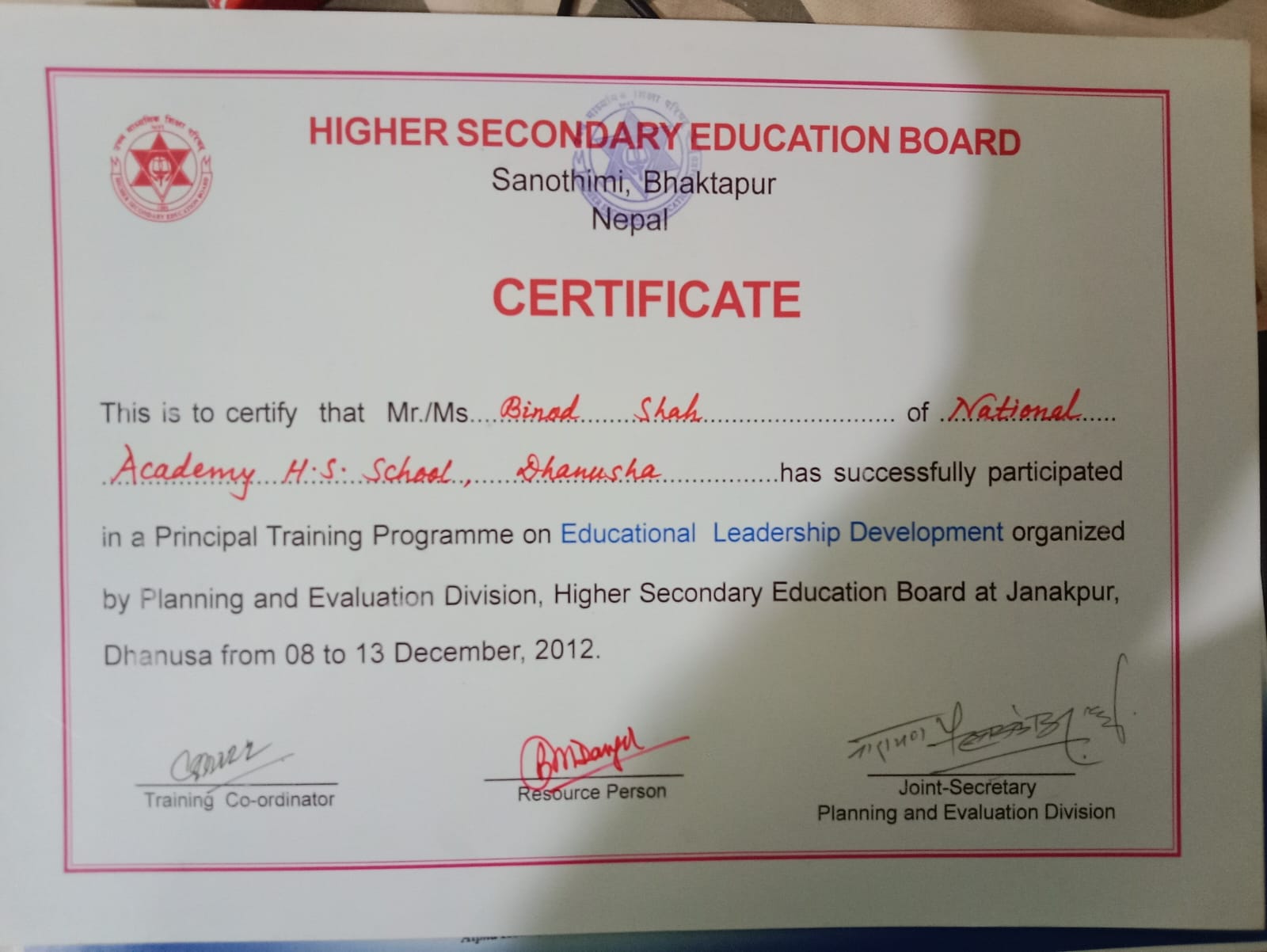
Educational Leadership Development
Awards & Achievements (2)
🏆 Rastriya Siksha Samman
🏆 Nepal Bidhya Bhushan Padak"Ka"
Invited Position (1)
Head, Management Research Cell
Role in Research Journals (3)
Associate Editor
Editor-in-Chief

Reviewer
JMVRA
Publications (18)
This research paper seeks to perform a thorough assessment of the financial stability and efficacy of commercial banks in Nepal, utilizing the CAMELS analysis framework. The CAMEL framework, incorpora...
In today's rapidly evolving and highly competitive business environment, organizations seek sustainable competitive advantages and enhanced performance through strategic management accounting (SMA). T...
This study examines the relationship between emotional intelligence (EI) and workplace productivity,
exploring how EI influences individual and organizational performance. Emotional intelligence, def...
Corporate sustainability plays a crucial role in the success of organizations, including the insurance sector. Investing in
social responsibility enhances the public's perception and ownership toward...
The goal of this research is to explore the ‘Practice of Corporate Governance and Its Impact on Perceived
Performance in Nepalese Life Insurance Companies’. The study used a descriptive and causal co...
dd